Will strict QC standards on T10 steel katana models cut long‑term support costs?

This time-honored Japanese sword exists as a remarkable work of art, but imagine you aim to to demonstrate your particular aesthetic? Tailoring your weapon is a significant journey, allowing you to craft a truly unique piece. From the hold wrapping and fitting to the barrier design and temper line, each part offers a chance for unique expression. This analysis delves into the area of katana adjustments, providing facts for both beginners and proficient enthusiasts searching to leave their legacy on the long-standing art of the samurai.
Introductory Real Creation
For beginners wanting to embark on the gratifying journey of Japanese swordsmanship , 1060 steel katanas provide an superior entry point. This selected grade of fundamental steel hits a optimal point between economical cost and proficiency. While below hard as supreme steels, 1060 allows for a manageable level of blade refinement , making it fitting for apprentices to cultivate the preliminaries of sword maintenance and experience the grace of handcrafted Japanese weaponry. It’s a excellent choice for acquiring experience without the capital burden of more high-grade steels.
Ten Ten Steel Cutting Tools : Managing Efficiency and Budget
Enabling fans seeking an authentic weapon experience without surpassing the finances , T10 compound katanas represent a favorable option. These blades offer a reasonable improvement in toughness compared to lower-grade alternatives, exhibiting decent edge retention and fair flexibility for initial hacking techniques. While not rivaling the excellent characteristics of elite steels like T100 or folded alloy , T10 provides a impressive blend of functionality and profitability, making them a sought-after choice for initiates and those on a tight budget .
Going past the Keel : Adapting Your Cutting Weapon's Fittings and Grasp
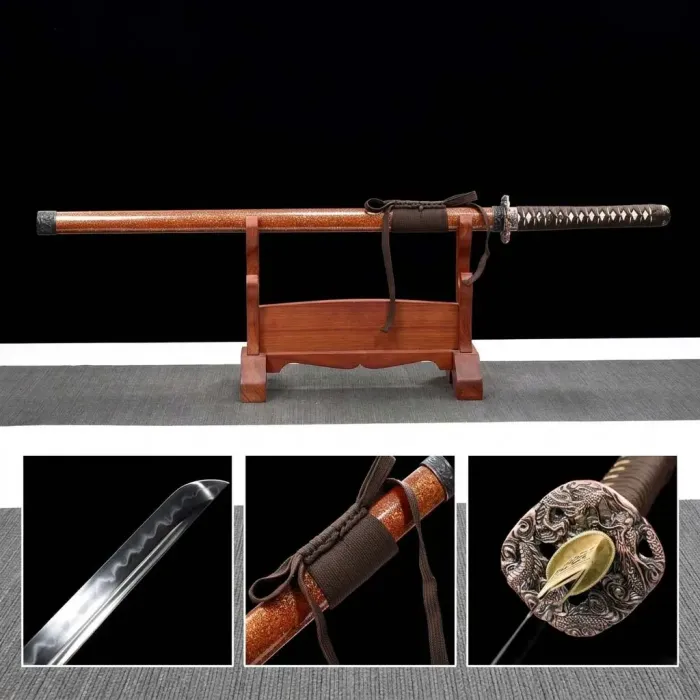
Whereas the sharpened blade is undeniably the important point of a katana, truly improving its aesthetic lies in the detailed customization of its accessories and grip . This operation allows admirers to demonstrate their inimitable manner . Think about the comprehensive possibilities: menuki - decorative charms that contribute visual detail ; the hamon enclosures – often intricately etched ; the tsuka nucleus itself, wrapped in traditional ito cord ; and the fusa cap, which can be fashioned from various fabrications like ornaments or horn .
- Pick themes that harmonize with you.
- Delve into with assorted mediums.
- Focus on robustness for a long-term mark .
The Charm of the Katana: Heritage, Workmanship, and Metal
That traditional armament possesses a exclusive allure, steeped in phases of Nippon's history and culture . More than merely a contraption of warfare , it's a icon of the samurai ethos – a fusion of mastery and governance . Its expansion spanned several generations, with early steel evolving into the sleek-lined curvature and fatal edge we understand today. The construction involved is truly remarkable , requiring decades of apprenticeship to attain . The process involves a multifaceted folding of tamahagane , creating layers that amplify the edge’s flexibility and cutting ability. Multiple schools of crafting appeared , each with their special secrets and formulas for achieving the ideal steadiness and crispness - a truly laborious pursuit.
- Initial Katana shapes
- The purpose of the samurai blade in fighter culture
- Old-fashioned blacksmithing styles
Opting for the Optimal Steel for Your Sword Project Project: 1060 vs. T10
Picking the proper steel is fundamentally important for any armament project, and the determination between 1060 and T10 can be difficult. 1060 is a favored American alloy, offering a decent balance of strength and katana sword toughness, facilitating it appropriately easy to manage. However, T10, a Oriental steel, ordinarily boasts increased wear durability and can arguably achieve a greater terminal hardness, although it can be substantially complex to operate and requires exact heat processing. Consider your experience level and aimed attributes: for a rookie, 1060 may be a simpler starting point, while the expert smith might value the supplementary qualities of T10.
- Accessibility of Controlling
- Corrosion
- Peak Hardness
Unlocking the Potential: Advanced Katana Customization Techniques
Excelling in the craft of sword improvement extends far beyond basic finishing. Serious smiths are now researching advanced techniques to truly unleash a blade's hidden potential. This involves intricate work with the temper pattern, utilizing specialized compositions for differential strengthening and carefully choosing the configuration of the shield to optimize balance and effectiveness. Beyond purely functional enhancements, artisans are increasingly focused on attaining unparalleled aesthetic appeal, through complex imprinting and layered coatings that truly transform a katana into a artistic composition.
Building a 1060 Sword from Basic Metal to Beauty
The journey commences with plain 1060 iron , a solid material far distant the deluxe katana it will transform . Proficient bladesmiths utilize a sophisticated process of folding and hammering the primitive steel, repeatedly firing it and flattening it to extract impurities and establish a consistent grain structure. This exhausting process, often going on for months , builds the imperative solidity and give characteristic of a legitimate Japanese sword . Subsequent heat adjustments , including precise hardening and quenching , are fundamental to achieve the expected equilibrium of sharpness, permanence and splendor .- Folding: Eliminates impurities and produces grain structure.
- Fabricating: Shapes the steel into the initial blade form.
- Annealing: Establishes the final hardness and flexibility.
The Perpetual Attraction of the Katana: Extensive Study of Steel and Alteration
Such long-standing katana survives a striking symbol within Japanese tradition , its attraction far overtopping mere military gear. Forged from traditional steel and often featuring intricate patterns , the technique of creation itself is a hallowed art. Beyond the primary craftsmanship, the ability to adapt a katana - from the quench mark to the shaft wrapping and fitting - affords for a honestly individual demonstration for both worshippers and followers alike. This amalgamation of classical steelwork and boundless personalization creates the katana's continued widespread acceptance across the universe.